
When a drawing calls for a white metal bearing, it rarely means a solid block of silver-colored metal. In industrial equipment, white metal is usually the Babbitt alloy forming the running surface. The finished part also has a backing or shell and a specified fit with its shaft or thrust collar. Identify the part before requesting a quote.
Is White Metal the Same as Babbitt?
In plain-bearing work, white metal and Babbitt commonly refer to soft bearing alloys used as a lining. The terms are often interchangeable, but neither identifies a single composition. Tin-based and lead-based alloys exist, with other elements determined by grade. A drawing should state the alloy or an approved equivalent rather than just “white metal.”
The distinction matters when searching for white metal bearing material. An ingot is raw alloy for lining work, not a ready-to-install journal bearing or thrust pad.
How Is a White Metal Bearing Built?
A typical journal bearing has four working elements: the rotating shaft journal, a lubricating oil film, the Babbitt lining, and the supporting backing or bearing shell. The lining is bonded to the backing and then machined to the required running geometry. The backing carries the structure; the lining provides a conformable surface facing the shaft. Depending on the design, the backing may be steel or another specified material. A thrust bearing uses a similar lining principle on pads facing a rotating thrust collar, but its geometry and load direction differ.
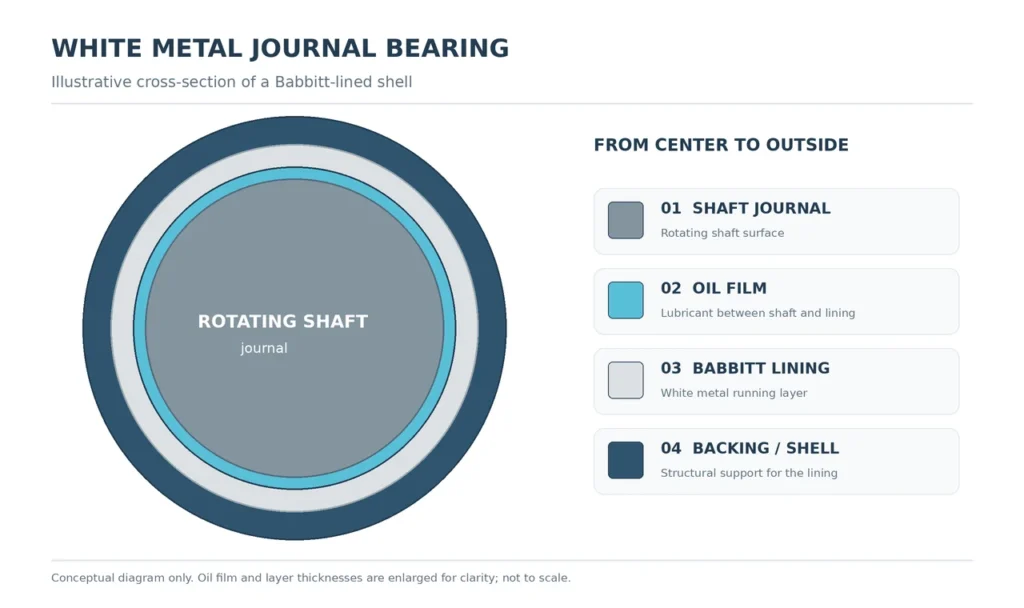
In normal full-film operation, oil separates the moving surfaces and carries load. Start-up, shutdown, contamination, or inadequate supply can disturb that film. Babbitt’s relatively soft surface can accommodate small imperfections and embed some fine debris, but it is neither oil-free nor immune to damage. Lining thickness, bond, groove placement, shaft condition, and lubrication must suit the machine. There is no universal white metal bearing clearance to copy from a web page.
This layered construction explains why a replacement request must identify the finished component. A split shell, journal-bearing insert, and tilting thrust pad may all use Babbitt, yet they are different parts with different drawings and inspection points. JED’s custom Babbitt bearing parts include shells, split structures, journal parts, and pads made to specified requirements.
Where Are White Metal Bearings Used?
White metal journal bearings support rotating shafts in selected mills, turbines, generators, compressors, and other large machines. Babbitt-lined thrust pads are used where a bearing must carry axial load. The machine name alone does not establish the bearing material: a given design might instead use a roller bearing, bronze surface, polymer pad, or another engineered arrangement. Confirm the OEM drawing and the actual bearing position.
For example, a grinding mill may have a Babbitt-lined main-bearing insert, while its trunnion liner and pinion bearing are separate components. JED describes drawing-based bearing shells for mining equipment and cement grinding equipment. In hydropower equipment, the relevant parts can include Babbitt-lined guide-bearing segments or thrust-bearing pads. These examples show where the material can be specified; they are not a claim that every mill or turbine uses the same white metal bearing.
What Defines a Custom Replacement Part?
For an OEM or maintenance replacement, send a drawing or verified data for the individual bearing part:
- The equipment model, bearing location, component number, and drawing revision.
- The Babbitt alloy specification, backing material, lining thickness, and any defined bond requirements.
- The finished bore or pad geometry, outside fit, width, split joint, and mating shaft or collar dimensions.
- Oil grooves, holes, feed orientation, and required surface and dimensional tolerances.
- Quantity, required delivery date, and the condition of any retained mating components.
An old sample and clear photos can help locate features, but wear may have changed its original profile and clearance. State which measurements come from the drawing and which come from the used part. If a journal or thrust collar will be restored, the final bearing geometry must be coordinated with its approved finished dimensions.
The white metal bearing price depends on more than the alloy: size, backing structure, lining process, machining, quantity, and agreed checks all affect a custom quote. A material grade alone cannot define the cost or the part. JED manufactures to drawings and reviewed replacement information; ask about the component you actually need rather than requesting a generic “Babbitt bearing.”
Send Your Bearing Drawing for Review
Need a Babbitt-lined shell, journal-bearing insert, or thrust pad? Send JED your drawing or part details for a manufacturing review. We can discuss the specified structure, lining, fits, and information needed to quote the custom component. If the project is tied to a shutdown, include the target delivery date in your inquiry.
Frequently Asked Questions
What if the original Babbitt alloy grade is unknown?
Do not choose a grade from the silver color of a worn lining. Send any OEM specification and an old-part sample if available. Material testing and the final grade should be agreed before production.
Can I request a single custom replacement bearing?
You can submit a one-piece or small-batch inquiry. Feasibility and minimum quantity depend on the backing, lining process, size, machining, and inspection requirements; they are confirmed after review.
What inspection documents can be supplied with the bearing?
Specify the material certificate, dimensional report, and any applicable bond or nondestructive examination in your inquiry. Availability and acceptance criteria should be agreed before production.